


Research at Sea!
- Sree Lekha J

- Jun 18, 2020
- 4 min read
Updated: Jul 6, 2020
I take immense pride in calling myself an oceanographer. I don't claim myself to be a very good oceanographer or anything but I constantly try to be good at what I'm doing. The learning curve is always steep! So you must be wondering "What do these oceanographers really do?" To put it in a simple layman's terms: We observe the ocean and try to understand what is really going on! When I say "observe" you might picturise an oceanographer on a beach with a pina colada in hand, but in reality they work really hard! For several centuries, dating back to the era of Greek philosophers like Aristotle (384-322 BC), man has always been curious about the ocean. But most of the understanding has been confined to the shallow oceans until Charles Wyville Thomson and Sir John Murray launched the Challenger Expedition (1872-1876) to observe the ocean ridges and marine trenches which laid foundation for modern oceanography.
In this post, I wanted to talk about my job as an oceanographer. For the past 7 years, as part of my doctoral research, I studied the salinity in the Bay of Bengal region. We all know the ocean is salty! But how do you define "salty"? The salinity in the ocean is measured as the amount of salt (grams) dissolved in 1 kg of seawater, reported in practical salinity units (psu). If you take the average salinity in the global ocean, it is about 34.8 psu. Bay of Bengal is a small basin bounded on the three sides by the Indian subcontinent, Bangladesh, Myanmar and also includes the Andaman and Nicobar islands. What is so special about Bay of Bengal? Every year, during June-September, enormous amount of freshwater is discharged into the Bay mainly from the monsoonal rivers and rain. Did you know that the Ganga-Brahmaputra river system discharging into the Bay is the world's third largest freshwater outlet followed by the Amazon and Congo! This large amount of freshwater alters the salinity in the Bay and at any time during the year the salinity in the northern Bay of Bengal ranges between 10-30 psu, still very fresh compared to the world oceans.

Surface salinity (colour) in the Bay of Bengal during different months as observed from a satellite.
We need to measure the salinity in the Bay of Bengal to answer several questions like: How this freshwater is moving around in the Bay? How is it affecting the salinity? What implications does this fresh layer of water has on the ocean dynamics? Salinity in the ocean can be measured remotely by satellites, profiling floats or we can just take a ship and navigate to the region of interest and measure the salinity, temperature etc. I have been on six research cruises (each 20-25 days long) so far and it has been an amazing and valuable experience. There is a lot of difference between working with data someone has acquired for you and understanding the data you measured from the ocean! My first 20-day cruise in the open ocean was in November 2013, when we encountered three tropical cyclones. It was very unpleasant sailing on the rough sea and dealing with lot of seasickness! I really couldn't do much! I thought I would never go back to the sea again! But everything changed on my second cruise. I was not sea sick this time!! I started to appreciate the efforts oceanographers put in to gather data! It was a unique learning experience to interact with senior scientists and understand the operation of several oceanographic instruments. A lot of effort and planning by a team of excellent scientists and engineers go into designing an experiment or planning an expedition. It is always a team work! A good amount of money is spent on the ship operations, ship and science crew and every single data point you collect! The team of young graduate students, senior scientists, ship crew relentlessly work all day in several shifts during the entire cruise to gather data, collect water samples to study chemical properties, understand the density changes in the ocean, understand the solar penetration into the ocean surface etc. All these problems in oceanography have implications for identifying the potential fishing zones, benefitting the fishing community and economy. Understanding the way ocean interacts with the atmosphere is important to predict the intensification of tropical cyclone before the landfall. Understanding the ocean processes is important in so many ways!


We sailed on research vessel ORV Sagar Nidhi. The Science crew gets shared cabin-accommodation. Most of the operations (deploying and recovering ocean instruments) happen on the deck space.


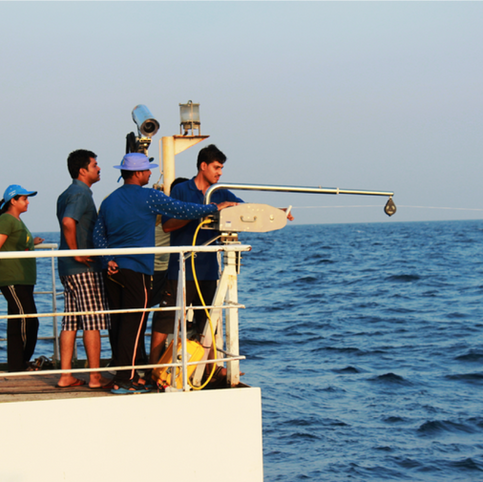


Having fun while working on the ship!


Pros of being an oceanographer: You get as close to the nature as possible!
I consider myself very fortunate to have gotten this opportunity to work at sea with many brilliant minds in oceanography! Though it seemed a little stressful in the beginning, it has been an enjoyable and quite an educating experience! Standing on the ship deck and just by looking at the vastness of the ocean around, you know that we understand so little and there is so much more to be discovered! For all those who are considering to apply to any research program in earth sciences or oceanography, I hope this post inspires you to go ahead and chase your dreams! For all the young minds, never stop being curious about nature! You never know where the curiosity takes you! Good luck!
Comments